Archives For November 30, 1999

Lo scorso 4 dicembre a Bologna, ho avuto l’onore di partecipare al convegno “Cooperare al presente: i social network come opportunità di business per un sistema a rete“, seminario nazionale organizzato dalle banche di credito cooperativo dell’Emilia Romagna.

Il convegno ha trattato di come le tecnologie, gli approcci e le strategie social possano contribuire al miglioramento e al rafforzamento del sistema bancario, mettendo al centro dei processi di gestione, di amministrazione e di comunicazione le persone.

Per loro caratteristica essenziale le Banche di Credito Cooperativo nascono come organizzazioni di rete, basate sugli scambi informali e formali e – soprattutto – come comunità che mettono al centro di tutto, le persone e le loro singole esperienze. Un ecosistema, quindi, dinamico che già pare essere predisposto – almeno sulla “carta” – all’evoluzione verso i ben noti scenari dell’Enterprise 2.0 e del Social Business.

Raccolgo in questo post qualche riflessione e qualche spunto interessante che è sorto durante la giornata e ne aggrego di nuovi, sperando di dare un contributo – anche modesto – nella comprensione di uno scenario che è mutato e di un mercato che si sta aprendo a nuove possibilità per tutti gli attori coinvolti: siano essi banche, consumatori, consulenti o dipendenti.

Schermata_2012-12-04_alle_17

Un buon report di Pricewaterhouse & Coopers dedicato proprio a questo tema (per maggiori informazioni si veda http://www.pwc.com/gx/en/banking-capital-markets/publications/digital-banking-survey.jhtml ) mette in evidenza alcuni aspetti davvero utili da riportare:

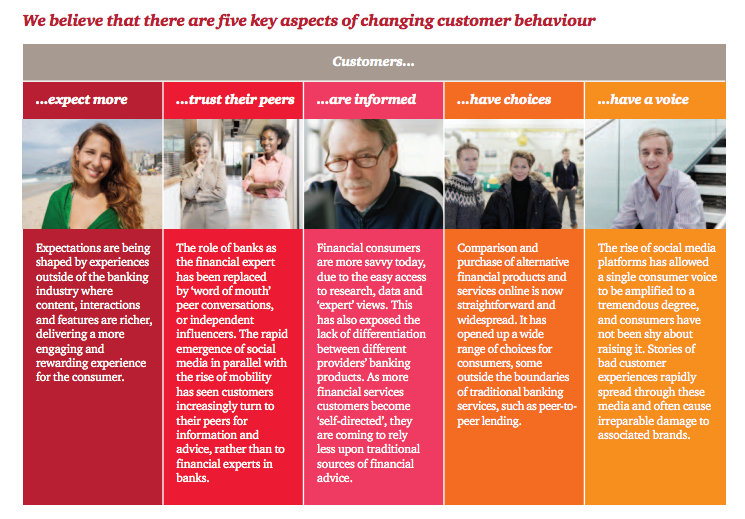
  •  i clienti – i consumatori – anche quelli delle banche, sono cambiati: la ripresa dello schema classico del Social Customer (di cui abbiamo ampiamente parlato e i cui riferimenti si trovano – in parte – anche qui: http://www.altimetergroup.com/2010/03/altimeter-report-the-18-use-cases-of-social-crm-the-new-rules-of-relationship-management.html ) viene evoluto verso logiche più legate al sistema bancario e al rapporto di gestione dei “nuovi clienti”. Lo schema riportato ben ricalca le nuove esigenze e i nuovi stimoli che arrivano da consumatori più attivi, più interessati; da clienti che sono più informati e più consapevoli nell’uso degli strumenti e nella ricerca del servizio di cui hanno bisogno (si veda in questa direzione la prima figura riportata). I consumatori di oggi giocano – quindi – un ruolo attivo sia nella scelta della banca sia nell’interazione che si viene a costruire con una determinata banca, ricercano un contatto costante, trasparenza, sono abituati a logiche di comunicazione immediate e informali (tipiche dei sistemi bottom-up) e si fidano molto di più della loro rete di pari rispetto a quello che viene comunicato da fonti “ufficiali”.
  • L’aumento degli appartenenti alla Generation Y e dei digital native impone cambiamenti di scenario consistenti ai quali le banche non possono essere indifferenti. Si tratta di una popolazione completamente nuova che parla un linguaggio differente e se non si è in grado di comprenderlo si rischia di essere completamente fuori mercato.
  • Nuovi player, nuovi “attacker” (come li definisce il report di PwC) cominciano ad affermarsi sul mercato mettendo in discussione e ponendo alle banche nuove sfide, nuovi stimoli, ma anche nuove opportunità per entrare in relazione con i loro consumatori e clienti. In questo senso basti pensare ad alcuni esempi come il mobile payment, nuovi formati e nuove tecnologie per le transazioni, nuove realtà che si affacciano in modo innovativo su questo mercato. Un esempio su tutti? Square: https://squareup.com/
  • L’utilizzo e l’applicazione di strumenti mobile e degli smartphone cambia la modalità di accesso all’informazione e ai servizi delle banche. Il dato si incrocia anche con il secondo punto di riflessione: i cosiddetti “nativi digitali” sono anche maggiormente portati, per loro natura e per loro attitudine (circa il 70% di loro va in questa direzione), all’accesso all’informazione tramite questi sistemi.
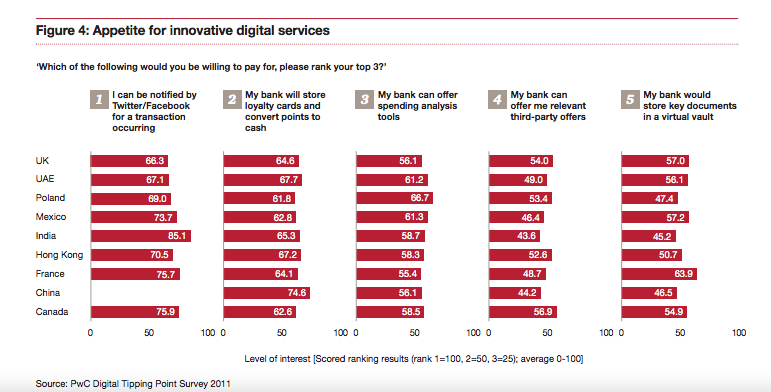
  • Un altro dato molto interessante è relativo al quanto potrebbero essere potenzialmente apprezzate alcune nuove tecnologie digitali nell’esperienza d’uso della banca da parte dei consumatori. Nello specifico particolarmente degna di nota risulta essere la riflessione su come un numero elevato di consumatori e di clienti vedrebbe in modo molto positivo l’integrazione con le piattaforme più note di social networking (nel grafico aggregato, che riporto a titolo di completezza e chiarezza, manca – per ovvi motivi – il dato della Cina)
  • A livello economico risulta utile anche riflettere su come i consumatori e i clienti delle banche sarebbero disposti a pagare un prezzo maggiore a fronte di servizi maggiormente integrati, innovativi e al “passo coi tempi”
  • Le banche dovranno fronteggiare in modo sempre più serio l’avvento – come già anticipato – di nuovi player, si stima che la battaglia più grande sarà giocata nel campo del Customer Care e del servizio al cliente, in questo senso si possono avanzare serie riflessioni anche nell’ambito del Social CRM e integrazioni più spinte (come già si sta iniziando a sperimentare oltreoceano) tra social media, interno ed esterno dell’organizzazione
Schermata_2012-12-04_alle_17

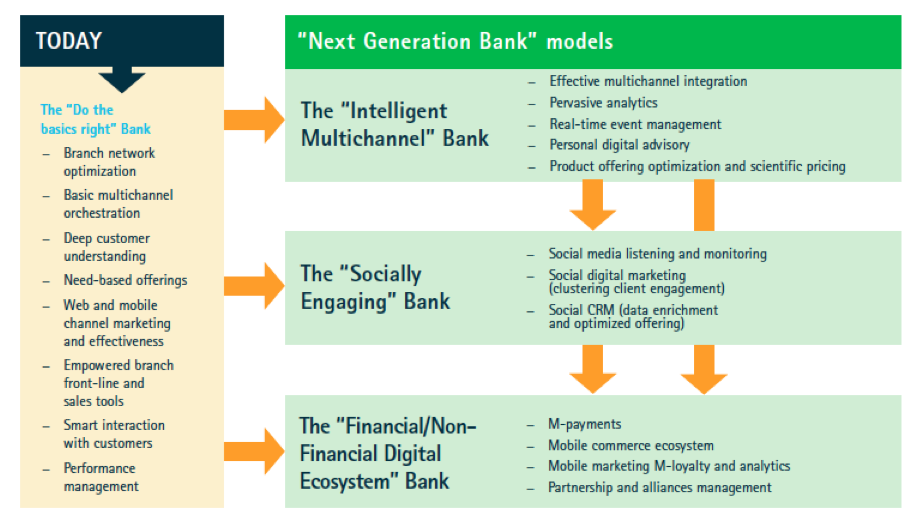
Un altro report molto interessante sul settore è quello di Accenture ( http://www.accenture.com/us-en/Pages/insight-banking-2016-next-generation-banking-summary.aspx ) che avanza considerazioni circa l’implementazione e l’utilizzo di tecnologie (non soltanto social) all’interno dell’azienda e nell’ambito del coinvolgimento sempre più efficace dei consumatori: RFID, Mobile Payment, Augmented Reality sono solo alcuni dei riferimenti che si possono incontrare, a testimonianza che il mondo del banking si sta muovendo in una direzione molto seria e ben precisa. Questo perlomeno per quanto riguarda i grossi player.

In questo senso risulta interessante lo schema riportato tratto dal report che mostra l’evoluzione delle banche nei prossimi 5-10 anni verso scenari collaborativi che fanno davvero riflettere
.

Schermata_2012-12-04_alle_18

Non solo verso l’estero però!

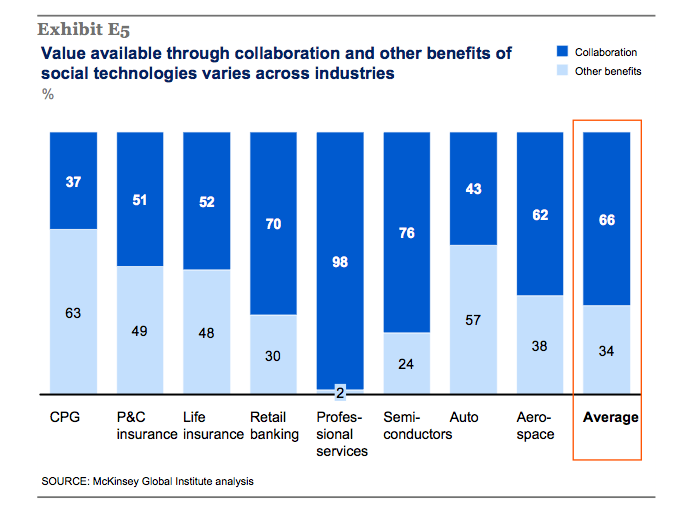
Anzi: come sottolinea anche McKinsey (si veda il grafico riportato) è soprattutto nel settore della collaborazione interna che è possibile aprire nuovi scenari e nuove prospettive di collaborazione verso l’interno dell’organizzazione. Un’applicazione molto interessante di questi principi è raccontata molto bene da Marco Minghetti in un suo articolo sul Sole 24 Ore in cui parla del caso Banca Ifis – http://marcominghetti.nova100.ilsole24ore.com/2012/11/hr-e-banking-20-il-caso-di-banca-ifis.html si tratta di una interessantissima sperimentazione in un contesto tutto italiano, che merita sicuramente un’attenzione particolare.

Degna di nota è la riflessione riportata

[…]
L’acquisizione di nuove aziende ci ha spinto, prima di tutto, a rivedere il “modello organizzativo” di riferimento, passando da un’organizzazione classica di tipo funzionale ad un modello di tipo “matriciale” in cui vi sono delle Business Unit a cui viene dato l’obiettivo di essere le “locomotive” della generazione del valore aziendale, supportate dalle funzioni di Staff che, “intersecando” le BU, si pongono l’obiettivo di supportarle, generando sinergia, efficienza, velocità. L’utilizzo della metafora della “matrice” è propedeutica al fatto di creare una rete di relazioni interne al Gruppo più chiare e funzionali al raggiungimento degli obiettivi specifici di ogni BU.
[…]

Schermata_2012-12-04_alle_13

Conclusioni e qualche riflessione personale

  • Esiste un grande potenziale per le banche (non solo quelle di Credito Cooperativo) per sfruttare queste tecnologie all’interno dei processi organizzativi per migliorare: la collaborazione interna, l’innovazione e il servizio al cliente.
  • Rispetto al mio personale intervento all’interno della giornata studio (dedicato a come i meccanismi HR e delle formazione delle banche) c’è da sottolineare l’ampia prospettiva possibile nell’effettuare un serio salto di qualità in questa direzione. Tuttavia rimangono molte perplessità sull’adozione di queste nuove logiche in ambito learning/formazione. Le resistenze che si incontrano (non solo in questo settore) sono molte e ampie e non sempre è possibile riuscire a fare innovazione su questi temi a partire dal contesto di riferimento. La sfida resta comunque aperta.
  • Il tema è sempre – o quasi sempre – un tema di cambiamento culturale e di mentalità. La tecnologia rappresenta un di cui, senza un cambiamento di mentalità di frame, di riflessione seria su questi temi è impossibile fare qualcosa.
  • La cultura e la formazione (o informazione ancora per i primi livelli) su questi temi non basta! Il rischio è quello sempre di rinchiudersi in casi, best practice, modelli che arrivano da settori che si giustificano come troppo lontani o troppo differenti dai nostri. E’ un caso tipico. Cosa ci insegna questo? Ci insegna che dopo la cultura, l’informazione, la teoria deve venire la pratica: il fare.
  • Il tema della valutazione – non solo della formazione – ma in generale degli impatti di queste tecnologie sull’impresa è sempre molto caldo e molto sentito. Non sempre è facile e immediato calcolare gli impatti (o il ROI se volete visto l’argomento), anche questo richiede pazienza, riflessioni ponderate e la capacità di guardare al futuro. Per nuovi fenomeni servono nuovi occhi, per nuovi contesti servono nuovi strumenti di valutazione.
  • I Social – l’ho detto e lo ripeto – non sono una panacea, non sono il Santo Graal della consulenza, sono strumenti: come tutti gli strumenti devono migliorare un contesto e devono aiutare a raggiungere un fine: quale? Qual è il fine? Il fine sono le persone. Gli strumenti servono a mettere le persone in grado di lavorare meglio, con più efficenza ed efficacia e …perché no, con una maggiore soddisfazione.

Sono diversi anni che mi occupo di Social Media Marketing, Social Media Monitoring, Listening, Brand Reputation e via dicendo. Sempre sigle diverse, sempre lo stesso concetto: sfruttare le reti e i meccanismi informali per aumentare la partecipazione degli utenti e per raggiungere nuovo pubblico.

Ma perché dovrebbe essere morto? E perché ho voluto scrivere questo post provocatorio? Il motivo è molto semplice: l’idea di base è stata quella di condividere alcune riflessioni che sono nate da alcune discussioni avvenute nei giorni scorsi con amici e colleghi su questi temi e provare a trovare motivazioni a supporto di una tesi fondamentale: il mercato, i consumatori e le aziende sono cambiate. E’ tempo di cambiare anche il nostro punto di vista evolvendo quello che già conosciamo. 

Cerchiamo di analizzare alcuni dati e di capire per quale motivo la situazione sta cambiando e in che direzione.

Cover

Gli influencer non esistono
Un recente articolo, molto interessante, di Micheal Wu pubblicato su Techcrunch – http://techcrunch.com/2012/11/09/can-social-media-influence-really-be-measured/ sottolinea una problematica ben nota a chi si occupa di questi temi e a chi è abituato anche a utilizzare tool per l’analisi della web reputation di fascia elevata (vedi Sysomos o Radian6).Tutti questi strumenti sembrano promettere il Santo Graal del Social Media Marketing: la ricerca, il tracciamento – e il successivo coinvolgimento quindi – degli influencer online.
Alcune riflessioni in questa direzione ci possono portare in fretta a ragionare su:

  • Le problematiche di misurazione degli influencer: le metriche sono spesso confuse, non chiare e non esistono – come sottolinea anche Wu nell’articolo – metodologie di validazione di quello che stiamo dicendo. Un modo, cioè, di stabilire effettivamente chi influenza chi rispetto a un modello, a un metro di paragone esterno ed efficace. Un esempio su tutti può essere fatto rispetto alla misura dell’influenza online che da Klout la cui attendibilità è ben chiara ad un occhio esperto e consapevole
  • In base a cosa stabiliamo un influencer? In base al numero di follower? In base al suo reach totale? Molto bene: si legga poco sotto il secondo paragrafo di questa riflessione. Forse possiamo stabilirlo in base al numero di Retweet e di Share per esempio che ottiene? Una buona metrica no? Così sembrerebbe… Date un’occhiata a questo articolo che sottolinea come solo una piccola percentuale di utenti che fanno RT legga effettivamente il contenuto rilanciato: http://blog.hubspot.com/blog/tabid/6307/bid/33815/New-Data-Indicates-Twitter-Users-Don-t-Always-Click-the-Links-They-Retweet-INFOGRAPHIC.aspx
    E’ chiaro quindi che ci troviamo di fronte a un problema di tecniche di misurazione, ma forse ancora prima a un problema legato al cosa stiamo effettivamente misurando.
  • Influencer rispetto a cosa? Manca anche una modalità di tracciamento a posteriori dell’influenza online. Come posso sapere se un determinato messaggio – e proprio quel messaggio – ha dato il via a un comportamento di consumo o a un qualunque comportamento? In questa direzione va la psicologia del comportamento e della decisione che da anni studia strategie e soluzioni per orientare il comportamento non prevedibile degli individui. La complessità della natura umana, ma anche degli stessi processi alla base della motivazione della decisione (ben spiegati – per esempio – nell’ottimo libro Drive di Daniel Pink) rende difficilmente applicabile il concetto di influencer in modo differente da quello di testimonial nell’advertising classico…
  • Influencer di cosa? Possiamo considerare che siano presenti influencer specifici rispetto a un tipo di settore particolare? Possiamo stabilire una misura concreta di questa influenza?

Più che di influencer in rete, quindi, forse si potrebbe parlare di un “pubblico interessato” di persone che in modo attivo e continuativo possono si occupano di un determinato tema divenendo esperti di quel tema, ma l’azione di coinvolgimento di queste persone, più che per spostare dei comportamenti degli altri utenti sarebbe interessante in un’ottica più matura, più completa: più vicina a quelle che sono le logiche del social business. Una logica di co-creazione in cui una volta che ho identificato gli utenti che si occupano del mio tema, del mio servizio del mio prodotto li coinvolgo all’interno del mio network al fine di migliorare il servizio al cliente, la capacità di fare innovazione, il mio prodotto o il mio servizio…

Il numero di follower o di like? Aria fritta
Non molto tempo fa suscitò molto scalpore la notizia di Marco Camisani Calzolari che riuscì a incrementare i suoli follower su Twitter ad un livello incredibile semplicemente acquistandoli ( http://www.repubblica.it/economia/2012/06/08/news/twitter_falsi_follower-36751066/ ). In questo senso non sono pochi i servizi che consentono di fare compravendita online di follower, di like e di aumentare la propria fan base. Ma a cosa serve tutto questo? Assolutamente a niente!
Mi capita spesso di confrontarmi con aziende o studenti – nei miei corsi – che mi domandano come aumentare i like di una pagina e/o i follower propri o di un brand su Twitter. Ebbene: il concetto è davvero sbagliato in partenza. Il numero di follower o di fan su Facebook, come su qualunque altra piattaforma, è solo una delle metriche che mostrano un ingaggio significativo e ben poco ci dicono dell’efficacia e di quanto quella pagina stia funzionando o meno nella creazione di un vero coinvolgimento nei confronti degli utenti. Il numero dei follower resta simile allo share televisivo, alla tiratura di un giornale: una modalità di ragionare ancora vecchio stile ancora con logiche classiche di pubblicità one 2 many. Ma con una postilla. Diamo un’occhiata a questo interessante post di Tech Crunch per esempio: http://techcrunch.com/2012/11/16/facebook-has-decreased-page-reach-and-heres-why/
E a questa tabella che mostra in un paio di mesi come è diminuito il reach dei contenuti condivisi su una pagina Facebook:

1

Vien naturale domandarsi: a che cosa serve avere 1 milione di follower se poi il mio pubblico resta una minima parte di questi? Che cosa cambia da un passaggio in televisione? Nulla apparentemente…
Accanto a tutto questo va ovviamente aggiunto il fatto che se non vengono fatte iniziative specifiche sui fan e sulla propria customer base è assolutamente inutile qualunque successiva riflessione. Vedremo più avanti nel post in che senso.

Il Social ADV e il Customer Engagament? L’inizio della fine
In un recente post Emanuele Quintarelli riporta alcuni interessanti dati di ricerca sull’andamento di Facebook rispetto all’efficacia di coinvolgere e di arrivare ai consumatori orientandone la conversazione. I dati che vengono illustrati sono abbastanza preoccupanti: http://www.socialenterprise.it/index.php/2012/07/28/perche-facebook-non-e-una-social-media-strategy/

  • La motivazione che spinge le persone a essere sui social network è in minima parte (12%) legata al mantenimento o allo stabilire una relazione con i brand e con le aziende.
  • Le brand community risultano una fonte molto molto migliore per la risoluzione dei problemi e per cercare informazioni che interessano grazie all’aiuto di propri pari.
  • E’ molto più facile che utenti ingaggiati all’interno di brand community si trasformino in brand ambassador e advocate all’interno di canali social in modo spontaneo.
  • Gli Analytics sono completamente inutili se non uniti a strumenti di intelligence e ad azioni puntuali (vedi anche il processo di monitoring in questo senso). Il monitoraggio, la misurazione l’analisi servono nella misura in cui portano dei risultati concreti sui benefici dell’organizzazione.

Credo che il dato più interessante in questo caso – nell’intero post di Emanuele – sia quello che riporta come agli utenti interessi davvero poco quello che dicono i brand di loro in rete e su Facebook ma piuttosto le conversazioni tra altri utenti come loro.

Nella stessa direzione di prima vanno alcune riflessioni condivise recentemente sul blog di Young Digital Lab in un post dedicato proprio al tema: http://www.youngdigitallab.com/facebook/facebook-social-network/. Nel post si parla di alcuni dati interessanti tra cui quello che sottolinea come solo il 15% (se non meno) della nostra fan base legga effettivamente i post che condividiamo nelle nostre pagine a questo dato va ovviamente agganciato il fatto che se solo il 15% dei nostri fan legge il nostro contenuto sarà – ovviamente – ancora minore la percentuale di utenti ingaggiati. Potete facilmente dedurre da soli che il quadro che ne esce è tutt’altro che confortante. Ancora una volta stiamo usando vecchie metriche (reach, follower, diffusione del contenuto) che sono quelle proprie di un advertising e di un marketing non troppo dissimile da quello tradizionale a cui siamo stati abituati. 

In questa direzione molto significativo risulta il commento che viene riportato:

“We post seven days a week, that would be about $14,000 per week, $56,000 per month… a grand total of $672,000 for what we got for free before Facebook started turning the traffic spigot down.” 

La riflessione riportata viene dal blog Dangerous Mind – http://dangerousminds.net/comments/facebook_i_want_my_friends_back e sottolinea una problematica molto consistente con la quale i brand si stanno confrontando, ovverosia: il costo completo che dovrebbero sostenere – tramite l’ultima novità dei promoted post – per ingaggiare e far arrivare il proprio messaggio a tutta la customer base. Interessante non trovate? Pagare cifre altissime per raggiungere persone che – in teoria – dovrebbero essere interessate al nostro messaggio. Pagare per “riprendere utenti che dovrebbero essere nostri”…

2

Se il Social ADV è da un lato un potentissimo strumento per aumentare la fan base, per attirare nuovo pubblico o per spingere i contenuti sulla timeline degli utenti, risulta altrettanto interessante notare come il processo stia rassomigliando sempre di più a un processo di pubblicità tradizionale e Facebook stessa – spinta dall’esigenza di monetizzare – sia costretta a risultare sempre più invasiva e pervasiva rispetto a questo tema: non è raro trovare articoli di lamentela e denunce dei comportamenti troppo legati all’ADV che il noto SN sta assumendo. Cosa significa? Ancora una volta la logica è quella del marketing e della pubblicità tradizionale: più ne raggiungiamo meglio è.
In questo senso si vedano anche i dati di questa ricerca sul tema del coinvolgimento degli utenti all’interno del noto SNS – http://adage.com/article/digitalnext/things-mark-zuckerberg-cmo/229293/
Anche alcuni articoli di Forrester – http://blogs.forrester.com/nate_elliott/12-05-14-facebook_needs_to_take_marketing_seriously – di qualche mese fa e la nota polemica che era scaturita dalle lamentele di General Motors sul fatto che l’ADV su queste piattaforme non funzionasse come avrebbe dovuto – http://online.wsj.com/article/SB10001424052702304192704577406394017764460.html

Schermata_2012-11-17_a_17

Quale efficacia per il web monitoring?
Più e più volte mi sono occupato, in questa e in altre sedi di parlare di social media listening, web monitoring e brand reputation. L’importanza dell’ascolto, lo abbiamo detto in più occasioni è chiave e fondamentale ma bisogna anche essere consapevoli che una volta maturata questa comprensione necessario fare dell’altro. Troppo spesso in questi anni ho condotto progetti di web reputation e monitoring che sono stati apprezzati ma che si sono esauriti nello spazio di un report. Fare ascolto in rete, comprendere le esigenze dei consumatori, intercettare linee di tendenza, trend e comprendere come si orienta il sentiment delle discussioni online è fondamentale, è vero: ma è solo il primo passo, il primo di un lungo cammino che deve portare le aziende ad evolversi ad ascoltare non solo i consumatori ma anche i propri dipendenti, a rimettere le persone al centro dello scambio e della produzione del valore.
Troppe troppe volte ho visto analisi di web reputation condotte come analisi di mercato. Quest
o processo di monitoring, di ascolto, di comprensione della propria reputazione online è efficace nella misura in cui è connesso a un profondo processo di trasformazione e funziona nel momento in cui si connette intimamente con quelle che sono le specifiche esigenze della singola azienda e organizzazione (esigenze che sono sempre diverse, sempre variegate)

E quindi? Adesso cosa si fa?
Si ricomincia da capo. Si ricomincia considerando il Social non tanto come il punto di arrivo ma come uno strumento al pari di tanti, molteplici, strumenti che possono servire alle aziende, non dissimile da tante altre strategie da tante altre pratiche. In questo senso mi sembra interessante considerare che il Social funziona – e lo testimoniano i veri casi di successo internazionali, nella misura in cui è profondamente connesso ai processi interni ed esterni dell’azienda. Il Social, il fare social media marketing nel caso specifico non è il cambiamento né da risultati. Il vero cambiamento è dentro e fuori l’azienda verso modelli nuovi, più efficaci, più efficienti in grado di mettere non tanto il consumatore ma le persone al centro di tutti i processi (siano essi esterni, siano essi interni).
Più in sintesi e nel tentativo di fissare alcun conclusioni di una riflessione che è ancora in fieri per quanto mi riguarda:

  • E’ necessario collegare i social media a processi aziendali e organizzativi strutturati e fare in modo che non divengano l’obiettivo, ma lo strumento, non il fine ma il mezzo
  • L’obiettivo è quello di aumentare il valore dell’organizzazione, rendere i processi più efficaci ed efficienti e mettere al centro gli utenti, le persone
  • Il Social Media Monitoring, funziona nella misura in cui è legato a precisi obiettivi di business, misurabili e concreti e viene visto non come il punto di arrivo ma come il punto di partenza di una strategia a 360° sui social media
  • KPI e metriche di questo mondo ( come quelle che elabora Edelman da anni a questa parte – http://www.edelmandigital.com/2011/08/30/how-to-measure-social-media-pr/ ) per essere efficaci devono essere collegate a fattori concreti all’interno dell’organizzazione. Metriche come il numero di follower, il numero di condivisioni, il numero di commenti e il coinvolgimento degli utenti sono inutili se non collegate a quello che ci sta dietro: risoluzione di problemi, miglioramento del processo di innovazione, aumento dell’efficacia organizzativa e via dicendo.
  • Offrire un’esperienza integrata che punti non tanto su tecniche specifiche di un singolo canale quanto su visioni più ampie, più precise più di dettaglio che abbiano al centro appunto non la preoccupazione della scelta della piattaforma più adatta ma agli obiettivi e al cosa si vuole ottenere
  • Uscire dall’idea totalizzante del Social Network: potrebbe non essere la scelta migliore, potrebbe non essere quella adeguata, in questo senso ormai tutti sono su Facebook, tutti si stanno muovendo senza consapevolezza (o con livelli più o meno diversi) nella creazione di pagine, nella costruzione di fan base, nella mobilitazione di risorse. Senza aver compreso né i cambiamenti che sono avvenuti, né quello che sta succedendo e senza aver chiara nemmeno la direzione del mercato.
  • Creare ambienti ad hoc: la creazione di brand community e di ambienti dedicati al Social CRM all’innovazione alla co-costruzione con i dipendenti e con i clienti è sicuramente molto più interessante. Questo consente – sebbene a fronte di un investimento iniziale molto superiore – di portarsi dietro una serie incredibile di vantaggi: customer base assicurata, fidelizzazione molto superiore degli utenti, analitche realizzabili ad hoc, ingaggio superiore degli utenti e via dicendo…
  • Progettare e realizzare esperienze più che canali. Esperienze che mettano al centro le persone e le loro esigenze. Poco importa la strategia o il canale scelto se si ha in mente questo obiettivo chiaro.

Prima del Customer Engagement c’è l’Engagement, prima dell’Engagement vengono i Consumatori, prima ancora dei Consumatori ci sono – poi – le Persone.

Nota a margine
Il tono volutamente polemico e provocatorio di questo post vuole semplicemente delineare che esattamente come 4/5 anni fa queste soluzioni hanno rappresentato il futuro, ora il mercato è cambiato: è maturo per nuovi approcci, per nuove idee, per nuove soluzioni. Questi approcci funzioneranno sicuramente ancora per un po’, ma la vera domanda restai, a mio avviso e per chi si occupa di questi temi: what’s next?
Francamente non ho visto particolare innovazione in questo settore da 2/3 anni a questa parte e sappiamo che chi sopravvive non è quello più forte o più grosso ma quello che sa meglio adattarsi a circostanze che – in questi ambienti molto più che in altri – mutano alla velocità della luce. 

Paolo Calderari di Palazzolo, Andrea Pesoli
Originally part of the Social Business Manifesto published for Harvard Business Review Italia by OpenKnowledge team. Read more on: 
http://socialbusinessmanifesto.com/ 

“Creativity in itself shouldn’t be encouraged: we instead need to encourage creative solutions to real problems. Innovation is only “good” when it’s useful.”

“There’s no such thing as a bad idea! Just poorly executed awesome ones.”

Look beyond innovation for the sake of innovation. More and more organizations today find themselves having to find and exploit new ideas and opportunities in order to respond to growing competitive pressure and to changes in customers’ needs. The recent economic recession has only further accelerated the urgency of this change and the “demand” for innovation for companies.

The main objective of innovation is not (only) to create the next hot product. Various types of innovation exist and people need to be engaged and stimulated to recognise and pursue not only product innovation, but also process or business model innovation. We need a way to encourage innovation and make it “normal”, namely not to separate it from the rest of the business. It has to be treated systematically, like any process in which a problem is determined and a solution is found. Some of the key questions we need to ask ourselves are therefore: What do we want to obtain and how? What resources will we need? Who will be part of the team? What will be the factors to motivate people and what recognitions will be given? How will the initiative’s success be measured?

Creativity therefore doesn’t have to be seen as a mysterious gift or prerogative of few “talents”, but as the – daily – activity of creating not obvious connections, putting things together that are normally not together. Innovation is always more the product of a collaborative process among individuals rather than the result of the intelligence of a single person.

What is Idea Management?

But where are all of these innovative ideas hidden that are so necessary to drive growth, productivity and value creation? When innovation is more important than ever, the collaborative management of ideas (collaborative idea management) through functions and geographical areas can help organizations to make new ideas emerge, and to refine them and ensure that they reach the right people. This approach is also a way to make employees more responsible and recognise the ones who are more active in the innovation process, so as to measure and stimulate creative activity and to promote a more open, collaborative and social culture in organizations. In other words, to create one or more innovation communities that work in a vertical or cross-cutting way in organizations.

Idea Management is a structured process – an integral part of the innovation process – aimed at the collection, management, selection and sharing of ideas. This process is typically supported by specific technologies (Idea Management Platform) that provide methods and tools that make the union of ideas, their assessment and – in some cases – even their execution, more effective and amplified. Idea Management can be applied in various contexts, from incremental improvements to more radical ones, and it can even cover the entire company ecosystem, including external stakeholders, partners and customers.

It is the social evolution of the traditional “idea box”, where, however, the use of the social processes and technological platforms of Idea Management profoundly transforms its nature:

  • Various forms of participation: these systems value the contribution not just of the idea proposal but also of the cross-valuation (vote), comment or criticism of the idea;
  • Contamination: everyone sees proposals from colleagues and a consistent idea can be born out of a proposal which in itself is not very concrete, or is unfocused, by enriching the information and/or concept;
  • Emergence: the most read, most commented or most appreciated ideas emerge and stand out from others, allowing the community to rapidly see the selection process in progress;
  • Collective Intelligence: if duly supported, the community can make proposals evolve by exploiting the intelligence and knowledge present in the system;
  • Focus on people (and not just on ideas): the proposals that stand out also identify a group of people who believe in the idea and who could also be involved in its implementation.

How to make the innovation process social

There are quite a few contributions that underline the importance of considering innovation as an open process that must involve many players within or outside the same business ecosystem.

The concept of “players” in the innovation process is important and interesting, because it reinterprets a “social” company role that is not always made clear in an organization chart (or rather not only focused on the R&D function) or in a specific organizational role. Unlike the traditional stage-gate selection process, the social approach to involvement and to the realisation of ideas and improvement projects is based on the activation of three different communities: he who brings or generates ideas (explorers, perhaps the most common meaning of innovator), he who carries them out (exploiters), and he who has the task of selecting and assessing them. It is precisely this last role, typically concentrated in Management, which is of fundamental importance for facilitating and “bridging the gap” between explorers and exploiters. Instead of acting as a restraint or gate-keeper (as a team would act by sticking to the assessment methods based on expert committees), the team has to act with a role of broker, a key figure who supports and accelerates the realisation of an idea.

A typical innovation process will therefore have the structure shown in Figure 1.

PHASE 1: Setting of objectives and scenario

  • Identify the topics and main areas of applicability of the initiative. A punctual analysis can help to understand both the sensitivity of an organization towards specific business topics and the level of cultural alignment on the social approach to innovation (readiness);
  • Identify the key players in the innovation process: therefore not only the formal figures, but above all – as we have already seen – those who already play an important role at an informal level (e.g. broker);
  • Specify and define the topics on which to start the first phase of idea production;
  • Involve and form the support team (experts, assessors, moderators, …).

PHASE 2: Generation of ideas

  • Launch the initiative on a restricted group of people (soft-launch) with the twofold objective of having a punctual feedback from end users and starting to populate the platform;
  • Involve a wider group in the generation of ideas (full-launch);
  • Punctually manage the growth of the community, timely intervening to “correct” negative behaviours (e.g. unconstructive comments, missing information, inappropriate language) and award positive ones (e.g. connections between ideas, precise comments, …);
  • Communicate the state of progress within and outside the community, also giving visibility to Top Management.

PHASE 3: Idea selection

  • Give visibility of the phase of approval of single ideas directly on the platform, punctually engaging the experts in the assessment;
  • Select the ideas (or groups of ideas), based on various KPIs. Ideally, the services on which it is important to concentrate are impact on the company (e.g.
    turnover increase, cost saving, scope of the idea, brand value, …) and feasibility (e.g. resources necessary, time to market, investment, …);
  • Award those who come up with the best ideas and…realise them!

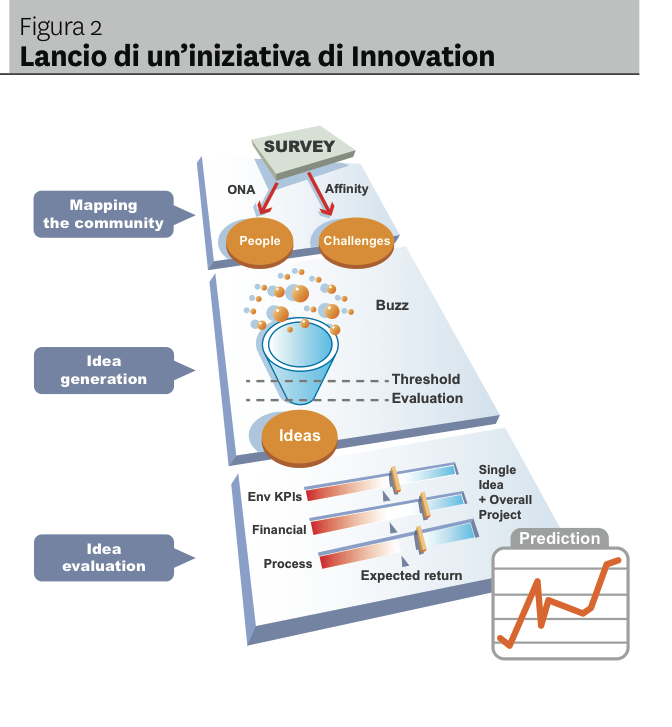
This process, especially in phases 2 and 3, can obviously be repeated whenever new innovation initiatives on specific topics are to be launched (see figure 2).

Schermata_2012-11-04_a_19

What to do and what not to do.

We end this article with a series of pieces of operational “advice” based on our experience:

  • Establish clear objectives. At times collaborative innovation initiatives are born within organizations as experiments or as extensions of collaborative social aspects. In these situations, the “learning by doing” approach sometimes takes over, and risks defocusing and dissolving the experience. In reality, to ensure the project’s success it is useful to initially identify clear business and result objectives, so as to strongly link the innovative process to an additional value brought to the organization and to its stakeholders.
  • Know the target. Before launching an innovation initiative, it is important to know who the participants in the process will be, in terms of profile, role, business unit and localisation in order to outline the best engagement strategy possible. Culture-country aspects must also not be underestimated. Tools like Social Network Analysis can also shed light on the existing collaborative dynamics and on the roles that some key players already play within the organization. These people should be punctually involved.
  • Manage the change and the alignment with the company strategy. The addition of an Idea Management tool must also be accompanied by a process of change management and alignment of the innovation initiative with the company strategy. There are many hidden barriers, firstly the natural low propensity to sharing and collaboration and the calling into question of formal roles. The communication, sharing and engagement of stakeholders in the process, especially if the approach is new within the company, are key to the initiative’s success and adoption.
  • Balance quality and level of engagement. Quality of ideas and level of engagement (e.g. number of people who actively participate) are two often conflicting objectives. We therefore need to know how to balance these two aspects in the various phases of maturity of the initiative, initially favouring engagement and introducing metrics to assess the quality of contributions once a certain consistency and stability has been reached in the community.
  • Exploit online and offline communication. As visually engaging and refined as it may be, online communication alone (email, launch videos, ….) still shows its limits. The best initiatives always mix online and offline elements in communication, especially when specific populations have to be involved in the initiative.
  • Being transparent in the assessment process. One of the weak points of the idea box approach is its lack of feedback in the assessment process. On open and social platforms, every remark, every feedback (e.g. a critical comment from an expert indicating the weak points of an idea) can be both the mainspring that makes the idea itself evolve and a moment of personal “formation” and formation for the community as a whole.
Schermata_2012-11-04_a_19

Finally, a few points for attention:

  • Only concentrating on the “numbers”. Modern platforms offer very refined and punctual analysis and reporting mechanisms. It is however important to avoid concentrating too much on the numbers alone (e.g. ideas, votes, comments posted, …), because the real value is in the interactions between people and the connections they generate. Different cultural backgrounds produce creativity and innovation. Favouring and appreciating different opinions, identities and perspectives therefore generates a greater level of innovation. Although it is possible to measure these dynamics, a linear relationship does not always exist with real added value. The phrase “Not everything that counts can be counted” is therefore valid.
  • Lowering the guard on community management. The promise to involve employees in an open, collaborative process of research and development of new ideas is certainly compelling. However, once the initial novelty and interest period has worn off, the community’s activity must be supported by constant specific communication and engagement initiatives. Be careful not to overestimate the impact of gamification dynamics which, alone, cannot increase and sustain the participation and involvement of users.
  • Sidelining usability and graphic aspects. The consumerisation of IT cannot be ignored. Users, whatever their profile or role, will definitely pay attention to aspects that are easy to use and access. It is therefore better to spend a bit of time making the user experience easy and pleasant.
  • Not involving sponsors/executives in the process. Innovation within large organizations is often thwarted by the presence of inflexibility, a uniform company culture, and communication flows that are too formalised. Executives therefore have the fundamental role of facilitating and accelerating the various phases of the innovation process and, ultimately, realising the ideas. Having finally stressed the aspects of change, the involvement of senior figures is important to lead (in terms of leadership) the cultural and – where possible – organizational change.

Di recente sto approfondendo uno dei temi che sembrano essere la classica next big thing (per dirla all’americana). I Big Data e il relativo studio di metriche e di analytics per comprenderne il valore e usarli nell’ambito organizzativo e di business. Che cosa sono ? Come funzionano? Come possono essere utilizzati e compresi?

Ma andiamo con ordine.
Che cosa sono i Big Data?

Big data usually includes data sets with sizes beyond the ability of commonly-used software tools to capture, curate, manage, and process the data within a tolerable elapsed time. Big data sizes are a constantly moving target, as of 2012 ranging from a few dozen terabytes to many petabytes of data in a single data set. With this difficulty, a new platform of “big data” tools has arisen to handle sensemaking over large quantities of data, as in the Apache Hadoop Big Data Platform.
MIKE2.0
, an open approach to Information Management, defines big data in terms of useful permutations, complexity, and difficulty to delete individual records. In a 2001 research report and related lectures, META Group (now Gartner) analyst Doug Laney defined data growth challenges and opportunities as being three-dimensional, i.e. increasing volume (amount of data), velocity (speed of data in and out), and variety (range of data types and sources). Gartner, and now much of the industry, continue to use this “3Vs” model for describing big data. In 2012, Gartnerupdated its definition as follows: “Big Data are high-volume, high-velocity, and/or high-variety information assets that require new forms of processing to enable enhanced decision making, insight discovery and process optimization”.
In 2012 Courtney Lambert extended the Gartner definition to “4Vs” by adding the term ‘virtual’, thus scoping the discussion to only include online assets.

In sostanza l’accento è posto su alcune dimensioni fondamentali che caratterizzano questa enorme mole di dati. Le dimensioni chiave sono quindi:

  • Il volume: la mole e la quantità di questi dati raggiunge dimensioni assolutamente imponenti (per fare un esempio basti pensare al CERN di Ginevra dove il LHC rilascia ogni secondo oltre 4Gb di dati e solo una minima parte viene selezionata e utilizzata per le analisi)
  • la velocità: incredibile ed elevatissima in cui questi dati vengono diffusi e aumentano di volume, rappresentando una vera sfida per gli analisti e per gli strumenti stessi di misurazione
  • la varietà: i dati, i big data, possono essere anche molto differenti tra loro
  • Infine sulla 4V ci sono diverse scuole di pensiero che coprono a volte la virtualità dei dati a volte la veracità, in questo secondo caso l’accento è posto sulla difficoltà nella gestione di questi dati e sulla complessità che molto spesso presentano proprio a causa dell’estrema varietà e indefinitezza in cui spesso ci si trova a lavorare.
Schermata_2012-10-31_alle_10

Il fenomeno sta quindi cominciando ad uscire dalla aule universitarie e dai dipartimenti per muoversi dalla nicchia in cui era collocato. In questo senso possiamo considerare il fenomeno dei big data come un fenomeno molto complesso e altrettanto interessante che risulterà sicuramente utile monitorare in futuro. Sia per le organizzazioni sia per le società di consulenza.

Come si legge anche nel report di IBM dedicato all’argomento (ne consiglio vivamente la lettura. E’ disponibile a questo indirizzo: http://www-01.ibm.com/software/data/infosphere/bigdata-analytics.html )

“Big data” – which admittedly means many things to many people – is no longer confined to the realm of technology. Today it is a business priority, given its ability to profoundly affect commerce in the globally integrated economy. In addition to providing solutions to long-standing business challenges, big data inspires new ways to transform processes, organizations, entire industries and even society itself. Yet extensive media coverage makes it hard to distinguish hype from reality – what is really happening? Our newest research finds that organizations are using big data to target customer-centric outcomes, tap into internal data and build a better information ecosystem.

Ecco alcuni degli aspetti fondamentali che sono sottolineati nel report.

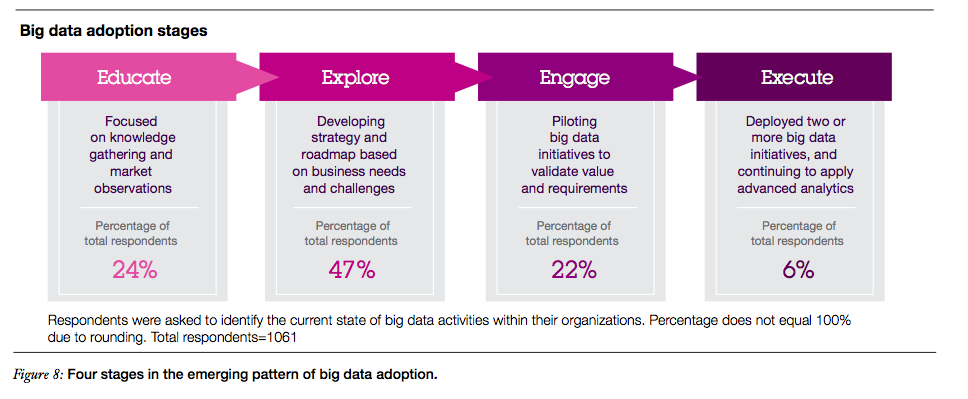
  • I Big Data si stanno evolvendo rapidamente muovendosi verso applicazioni più concrete e realizzazioni pratiche. I livelli di adozione e di crescita di consapevolezza sono ben rappresentati nello schema che segue. E’ necessario procedere per step sino ad aumentare il coinvolgimento delle diverse funzioni aziendali e comprendere in che modo questi strumenti possano essere utilizzati all’interno delle organizzazioni.
Schermata_2012-10-31_alle_11
  • I Big Data possono essere un’ottima leva per raggiungere, comprendere e relizzare le aspettative dei consumatori e dei clienti. Si tratta sicuramente di un’arma strategica molto importante che è bene comprendere.
    Come sottolinea anche Emanuela Zaccone (Zatomas) in quest’ottimo post: http://www.techeconomy.it/2012/09/28/big-data-e-social-media-monitoring-lingu… i big data possono essere un’ottima integrazione al processo di social media listening e monitoring fornendo nuovi volumi di dati e nuovi spunti in grado di migliorare il lavoro degli analisti.
  • I Big Data non solo sono un’eccellente strumento di lettura ma possono anche essere impiegati per anticipare istanze, problemi e per avere un quadro migliore del contesto e comprendere appieno l’ecosistema. Esattamente come per l’Organisational Network Analysis e la Social Network Analysis trovare modalità per visualizzare i big data potrebbe essere la chiave di accesso per dare un “volto” a ciò che di solito rimane senza corretta comprensione. Una migliore visione del quadro operativo è sicuramente il miglior modo per affrontare le sfide poste dal mercato.

In questo senso risulta interessante anche evidenziare gli aspetti del report di McKinsey dedicato all’argomento, di taglio
differente rispetto a quello IBM ma di sicuro interesse (il report è disponibile qui: http://www.mckinsey.com/insights/mgi/research/technology_and_innovation/big_d… )

Alcuni degli elementi che emergono da questo report sono:

  • Il mercato che ruota attorno ai Big Data è in fortissima crescita ed espansione. Alcuni dati? 5 miliardi sono gli smartphone usati nel 2010. 30 miliardi i contenuti condivisi su Facebook ogni mese.
  • I dati hanno assunto dimensioni sempre più importanti all’interno dello sviluppo del business e all’interno delle organizzazioni. Il loro utilizzo diviene sempre più chiave e cruciale all’interno degli scenari evolutivi delle aziende
  • I Big Data creano valore in molte e differenti modalità se correttamente impiegati e compresi. Nello specifico:
    • I Big Data rendono possibile una migliore trasparenza e un miglior utilizzo delle informazioni. In questo senso basti pensare all’importanza che i dati rivestono nel settore pubblico e in diversi ambiti. Se i dati dovessero diventare trasparenti e ricercabili da parte di tutti ne beneficerebbe molto la trasparenza
    • I dati sono fondamentali per migliorare le performance e comprendere meglio il contesto in cui si muovono le organizzazioni.
    • I dati ci aiutano a comprendere al meglio i nostri clienti e il nostro pubblico. Attraverso i dati possiamo anticipare le esigenze e ascoltare in modo più attivo le richieste dei consumatori convertendole in strategie di azione e momenti concreti. Attraverso i big data come viene sottolineando nel report sono utili anche per la segmentazione.
    • Automatizzare il processo di decision making e renderlo più semplice. Con l’uso di algoritmi che possano facilitare l’analisi del contesto è possibili facilitare di molto i processi di decision making e di problem solving all’interno delle organizzazioni.
    • Fornire nuovi spunti per i processi di innovazione partecipata

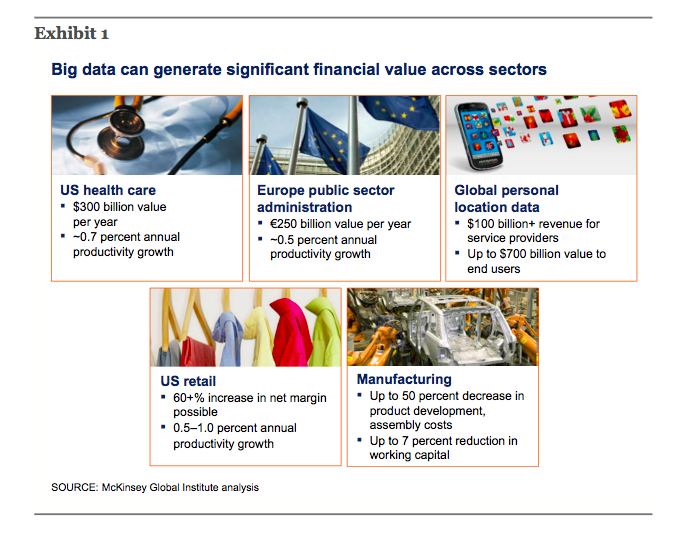
Alcune proiezioni di McKinsey sottolineato poi come i Big Data possano contribuire a innalzare di molto la produttività e il ritorno dell’investimento in alcuni specifici settori e industry:

Schermata_2012-10-31_alle_14

Di recente ho avuto modo di leggere il report (dello scorso Luglio – http://www.mckinsey.com/insights/mgi/research/technology_and_innovation/the_s… ) di McKinsey sullo stato dell’arte delle social technologies e sul valore che queste possono avere nel promuovere lo sviluppo delle organizzazioni.

La questione che mi sono posto – stimolato anche dalle ottime riflessioni di Emanuele Quintarelli ( http://www.socialenterprise.it/index.php/2012/08/13/sbloccare-il-potenziale-d… ) è quale possa essere – in Italia e nel mondo – il mercato e il livello di sviluppo, ad oggi, del social business.

Ma andiamo con ordine: cerchiamo come prima cosa di riassumere alcuni dei dati e delle considerazioni salienti del report realizzato da McKinsey:

  • Il livello di adozione e i tempi di penetrazione delle tecnologie social è incredibile: come ben mostrato nessuno strumento è riuscito a raggiungere i livelli dei social newtork e nessun media è riuscito a raggiungere – in cosi’ poco tempo – la stessa massa critica di questi strumenti. I tempi di diffusione e il potenziale che questi strumenti hanno nell’essere adottati non è assolutamente un fattore da sottovalutare in termini di impiego nelle organizzazioni. Tuttavia è bene riflettere come solo parte dell’intero potenziale della social communication è stato “sbloccato”. Molta è ancora la strada da fare e molte sono le riflessioni da maturare in questa direzione.
  • La capacità che questi strumenti hanno di massimizzare il valore scambiato e di facilitare i processi di collaborazione, comunicazione e innovazione è molto alta. In questo senso è possibile riflettere sugli impatti che strumenti social hanno avuto – e stanno tutt’ora avendo – sul nostro modo di comunicare, di relazionarci e di gestire le informazioni.
  • Esiste un potenziale economico che va da 900 miliardi a 1.3 trilioni di dollari che deve essere sbloccato e valorizzato. Il tutto è basato su alcune stime derivanti da una serie di survey che McKinsey ha portato avanti. La riflessione da fare in questo senso è legata sicuramente al ROI del social business e all’importanza che stanno assumendo nuovi strumenti per la misurazione di nuovi fenomeni.
  • Le tecnologie social – laddove correttamente implementate – possono aiutare le aziende a divenire dei network complessi basati sullo scambio di valore. In questo senso sono sin grado di massimizzare le capacità delle aziende di collaborare, di fare rete e di costruire nuovi modelli competitivi.
  • Il miglioramento della semplice comunicazione e dello scambio di informazioni (all’interno e all’esterno delle aziende) sarebbe in grado di aumentare del 25/30% la produttività dei knowledge worker
  • Le social technologies possono giocare un ruolo molto importante e fondamentale nel visualizzare i flussi di scambi informali e nel “cristallizzare” le conoscenza, le interazioni e le informazioni che sono presenti – molto spesso – solo a livello individuale.

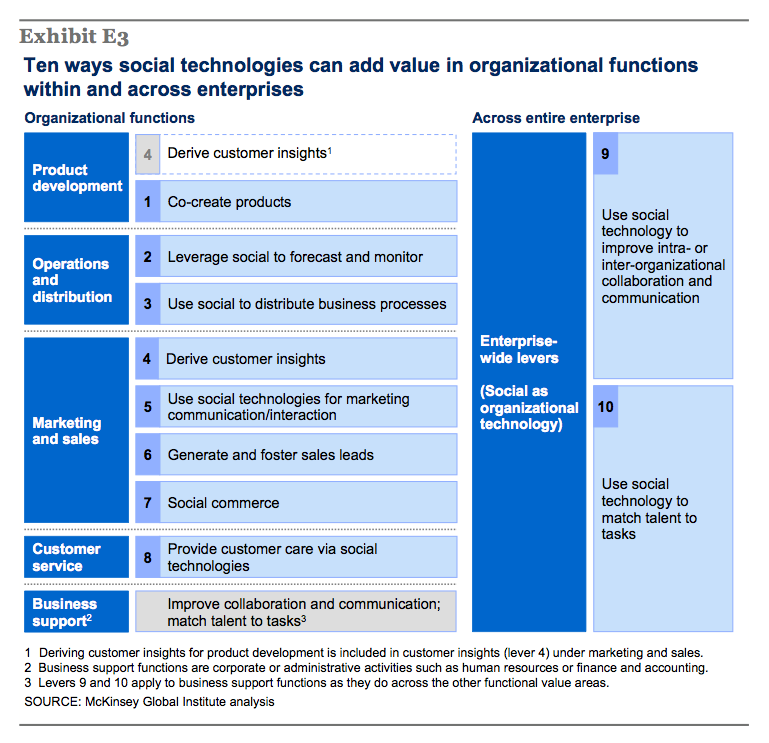
In questo senso è molto interessante vedere anche le funzioni aziendali su cui possono impattare le social technologies e a quale livello possono contribuire per promuovere lo sviluppo dell’organizzazione:

Schermata_2012-10-30_a_23

Come ben visibile dallo schema riportato si tratta di ambiti anche molto diversi ma sulle quali questi approcci possono essere estremamente interessanti su più livelli portando vantaggi notevoli.

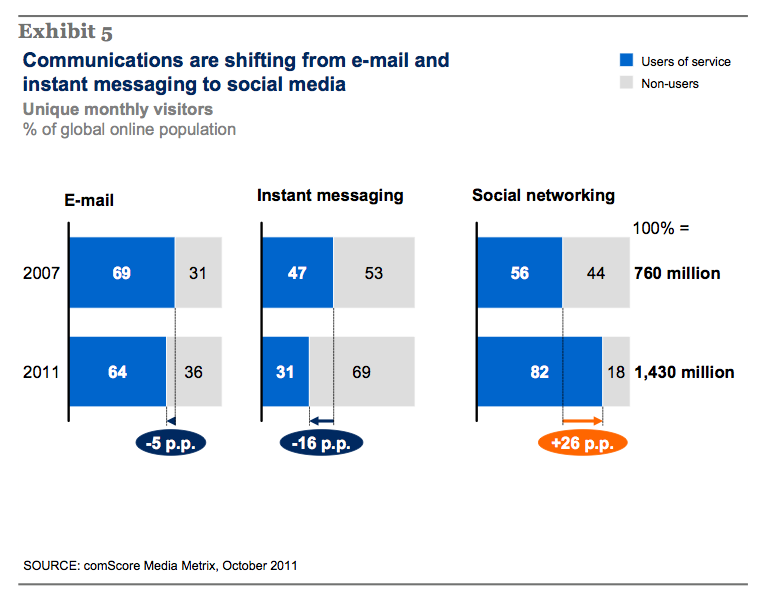
Un’altra riflessione interessante in questo senso risulta essere quella legata alle modalità di lavoro. Lo spostamento che il nostro modo di comunicare sta avendo nei confronti delle tecnologie social fa riflettere:

Schermata_2012-10-30_a_23

Celebre in questo senso è il caso di qualche anno fa di Luis Suarezhttp://www.wired.com/wiredenterprise/2012/01/luis-suarez/ – in questa stessa direzione sembra stiano maturando sempre maggiori consapevolezze. Nell’uso cioè di sistemi maggiormente dinamici, snelli e in grado di gestire carichi di informazioni sicuramente maggiore rispetto alla semplice email.

Alcune riflessioni personali a margine di quello che abbiamo visto (chiaramente si tratta di un’estrema sintesi di alcuni punti che sono emersi dal report e che vi consiglio assolutamente di leggere):

  • Il mercato è cambiato: sono sempre di più le aziende che avvertono quello che è il messaggio sotteso alle grandi storie di successo dei big brand internazionali: non possiamo più decidere se diventare o meno un social business. Dobbiamo semplicemente scegliere il modo migliore e più veloce per farlo. A proposito di casi di successo legati al social business e all’evoluzione del mercato ne ho parlato già qui: http://www.sociallearning.it/social-enterprise-le-migliori-storie-di-succe
  • Il cambiamento è trasversale e impatta tutte le aziende. Le riflessioni maturate in questi anni ci fanno considerare il processo di trasformazione verso un social business come un qualcosa di trasversale a tutte le unit di un’organizzazione e a tutte le industry in cui un’azienda è posizionata. Non esistono scenari migliori o più adatti di altri in cui applicare queste logiche. Anche se il report di McKinsey sottolinea alcune aziende favorite rispetto ad altre, in particolar modo quelle:
    • che impiegano un alto numero di knowledge workers
    • che fanno affidamento su una forte coesione con l’immagine del brand e che basano molta della loro interazione con i consumatori su questo
    • che hanno un’esperienza (come ad esempio un servizio) o un prodotto da offrire ai propri consumatori
  • Le strategie sui social media “verso l’esterno” sono insufficienti: le aziende e i consulenti cominciano a rendersi conto dell’incapacità di semplici strategie di social media marketing e della difficoltà di approcci one shot. Nulla risulta più efficace di un approccio integrato, maturo, valido sia per l’interno sia per l’esterno dell’azienda. In sostanza è tempo di evolvere le strategie di coinvolgimento dei clienti e dei consumatori in approcci più maturi che permettano alle organizzazioni di svilupparsi e di andare nella direzione di dinamiche che arricchiscano tanto i dipendenti quanti i clienti finali in un ecosistema aziendale armonico.
  • Le aziende cominciano ad essere più consapevoli :le richieste di so
    luzioni aumentano e non è più possibile fare come in passato. Le aziende cominciano a maturare consapevolezza rispetto a queste dinamiche e risulta importante proporre soluzioni nuove più mature e in grado di integrare veramente differenti approcci portando del concreto valore aggiunto.
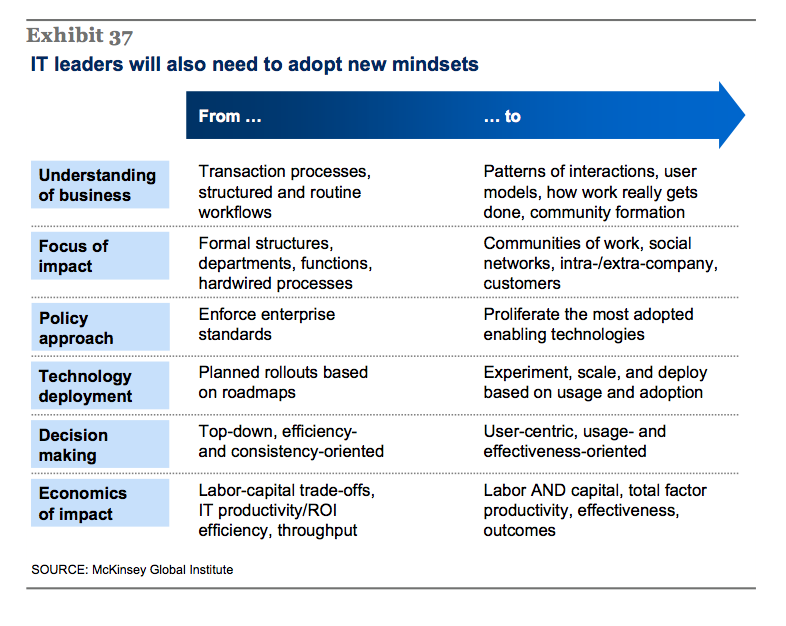
  • Sono necessarie nuove competenze e nuovi strumenti. Esattamente come per vedere nuove cose bisogna avere nuovi occhi e rinnovarsi (similmente a quanto ricordava Proust) è necessario che le organizzazioni si muovano verso modelli a competenze ibride, dove l’integrazione di diversi punti di vista puo’ solo rappresentare ricchezza e consentire la lettura di nuovi e vecchi fenomeni.

Come ben mostra questo grafico nello specifico degli IT manager:

Schermata_2012-10-30_a_23

E voi? Siete pronti a diventare un social business? Cosa ne pensate?

In occasione del Social Business Forum 2012 ( http://www.socialbusinessforum.com/?lang=it ) – che ho avuto il piacere di contribuire ad organizzare – Oracle ha realizzato una serie di video interviste con alcuni dei più grandi guru mondiali in ambito di Social Business e di Organizzazione partecipata.
In queste brevi interviste – che ho voluto raccogliere  in un unico post vengono affrontati temi molto interessanti per chi si occupa di consulenza organizzativa.

Dal Social Business alla resilienza organizzativa, dalla Gamification ai trend maggiormente significativi della collaborazione. Riflessioni sull’organizzazione del futuro e sull’utilizzo (efficace ed efficiente) dei social media nell’organizzazione.
Credo che queste brevi pillole possano servire sia ad un pubblico “immaturo” che si avvicina per le prime volte a questi temi, sia ad un utenza esperta che intende avere alcuni spunti di riflessione dai quali partire per maturare nuove strategie e nuovi processi

Di seguito riporto le video interviste che sono state realizzate.

John Hagel, Co-Chairman of the Center for the Edge at Deloitte & Touche (See Measuring the forces of long-term change – The 2009 Shift Index), provides strategic insights on how companies will succeed in the 21st century. 

L’intervento di Hagel risulta interessante per riflettere soprattutto perché sottolinea l’importanza delle metriche facendo riferimento allo Shift Index e avanza alcune delle teorie che sono presentate nel suo libro. Il fatto che le organizzazioni debbano muovere da un approccio push ad uno pull, creandopoattaforme scalabili che permettano di valorizzare le risorse delle organizzazioni nel tempo e nell’occasione giusta.

Il secondo intervento è di Steve Denning che propone un nuovo modo di fare management di fare organizzazione. Chiama questo modo Radical Management che riguarda il mettere al centro del business e dell’organizzazione del futuro le persone e i consumatori. Questo richiede un cambiamento radicale appunto che rappresenti una netta evolzione rispetto al sistema sociale economico e politico in cui abbiamo vissuto fino ad adesso

According to Steve Denning, in a phase change from old to a creative, collaborative, knowledge economy, the answer is hidden in a whole new business ecosystem that puts the individual (both the employee and the customer) at the center of the organization. He calls this new paradigm Radical Management and in the video interview he articulates the huge challenges and amazing rewards our enterprises are facing during this inevitable transition.

In this second video interview from the Social Business Forum, Christian Finn (Senior Director, WebCenter Product Management at Oracle) shared his vision regarding the social business journey by covering both the barriers preventing companies from gaining maximum result derived by people participation and provided valuable first-hand recommendations on how to overcome such hurdles.

Christian Finn sottolinea invece dal punto di vista di Oracle. Parlando di Social Business è sciuramente importante evitare di cadere nell’hype e nel cavalacare semplicemente una parola. Recentemente mi è capitato di avere una discussione su Twitter con alcune persone che sostenevano che il Social Business non fosse altro che una nuova etichetta per vendere cose vecchie. Il social business è in realtà un modo completamente nuovo di concepire il consumatore e l’organizzazione basato su nuovi approcci, nuove strategie, nuove tecnologie.

In questo senso anche Esteban Kolsky nel suo breve contributo ci aiuta a inquadrare meglio gli scenari e le carretterstiche del Social CRM analizzando come sia possibile dai dati e dalle informazioni a processi e azioni concrete.

In his interview for the Social Business Thought-Leaders, Esteban discusses how to turn social media hype in business gains by touching upon some of the hottest topics organizations face when approaching social support:
– How to go from social media monitoring to actionable insights
– How Social CRM should be best positioned in regard to traditional CRM
– The importance of integrating social data to transactional data

More than simply adding badges, points and leaderboards to existing processes, enterprise gamification should be holistically embedded into employee and customer experience to stimulate specific behaviors. 
Listen to Ray Wang’s video-interview to learn more about the dynamics that are shaping the future of collaboration and how gamification can help organizations attain new levels of engagement

Infine, ma non per questo meno importante Ray Wang, guru mondiale della Gamification, che abbiamo anche avuto modo di intervistare in questa stessa sede prima del Forum, sottolinea le modalità attraverso cui la collaborazione può cambiare le organizzazioni.

For decades business process mapping (BPM) has been the starting point for analyzing work processes. Total Quality Management, Lean Manufacturing, Six Sigma, and Business Process Re-engineering are all methods of work management that have the “Business Process” as their point of reference – and centre of attention – for business improvement.

When we try to break down the “Business Process” term we realize that its usage stretches far beyond the mechanical workflow processes, ideally pointed out by BPM techniques. For example: are the subtle negotiations between a seller and a customer adequately represented in a process map? What about the relationship between a social worker and client, or its network of reference? And what about the network that inspired the sale of Apple’s entertainment products? The understanding of a university professor’s lesson? The treatment from an expert doctor?

We can of course describe the above operations in terms of business processes, but in order to improve such processes we need to go beyond traditional mapping and analysis methods.

Stabell and Fieldstad in their pioneering work on “Value Chains” identified how business value can be generated through methods other than those of traditional simple process analysis. They also introduced the concept of “Value Shops” to satisfy the business processes driven by experts, such as medical centres, law firms, consultancy companies or research institutions, and “Value Networks” for businesses that thrived on client interdependence, as in the case of telecommunications, banks and entertainment businesses. All of these alternative business models have traditional process chain activities, but in no way do these activities represent the key process. Subjecting these models to traditional analysis techniques essentially means improperly using available resources, thus running the risk of not achieving satisfying results.

So if your business is not centred on Value Chains, what are the alternatives? Two mature approaches are used to analyse businesses related to Value Shops and Value Networks: Social Network Analysis (SNA) and Value Network Analysis (VNA).

Schermata-2012-07-02-a-21

SNA is able to identify the people within your organisation that others depend on in terms of work processes, information and support. In this sense SNA does not mean a method that simply covers technical expertise. In fact, in our experience, SNA has often uncovered matters related to organisational expertise, i.e. to those competencies that answer the questions: “how can we make sure that things work around here?” or “how can we make sure that the procurement system works for us?”, which also help to understand the relationship channels between your experts inside the business and the rest of the organisation. This is similar to a BPM for the more mechanical processes and offers the same level of analysis and benefits.

SNA can provide information both on Value Shops and on models based on Value Networks. VNA can underline – from its perspective – Value Networks and Value Chains by pointing out the client interdependencies and shaping the tangible and intangible flows that connect the different “roles” within the organisational network. SNA works, therefore, at the personal level and VNA works at the role level.

There is a gap between the two analyses that allows us to observe how organizational roles interact at the more personal level than at the work process level. We call this analysis gap Organisational Network Analysis (ONA), which simplistically can be traced back to an SNA with the “roles” as the network nodes, instead of the individuals. It differs from VNA because the connections between roles are not detailed and explicit like value flows, but simply identified by their degree of inter-role dependency. ONA can be complementary to both SNA and VNA and can address, in different ways, all three value configurations (figure 1).

In this document we will introduce the concept of ONA and illustrate it in detail with a case study.

Where would ONA be used?

Over the years we have conducted numerous SNA and VNA activities. These investigations were not only limited to Value Shops or Value Network businesses but also to Value Chains. Inevitably there are elements of both techniques that can limit the choice of adopting them. For SNA, for example, reluctance is typically connected with privacy issues and the presence (or non-presence) of some people within the social network map emerging from the concluded analysis may be observed as “uncomfortable”. All of this can be mediated by avoiding showing the names of people on the map, but we must not forget that an SNA in fact asks people to mention individuals by name. For VNA privacy is not a problem as the unit of analysis always refers to the “role”. Tangible value flows within the map created with VNA are familiar to those practised in traditional analysis techniques. Intangible value flows are instead often related to people – or centred on relationships – which can be perceived as “foreign” by VNA participants and can take some time to practise before they are acquired. As in BPM, the entire mapping process can be time consuming as each individual role is analysed for the contents of its value flows. All of this can often limit the level of organisational analysis that can be achieved.

Schermata-2012-07-02-a-21

By considering ONA as a meeting point between SNA and VNA, it is possible to achieve the benefits of both approaches while avoiding many of the limitations.

ONA is essentially an SNA conducted at the role level. Participants are asked to nominate “roles” rather than “people” they depend on for performing their job correctly and well, together with the degree of dependence they can have on certain roles. In this case, the privacy issues that emerge with SNA are therefore avoided (or at least they are for roles that have more than one occupant!). It is also much simpler (especially compared to VNA) for participants in the analyses to indicate the roles they depend on and refer to for their work processes.

The real positive side of ONA is that it could be much easier for organisations to adopt, given that it does not require the long analysis and processing time of VNA and it does not interfere with privacy and personal issues of employees, thus avoiding becoming an “uncomfortable” and expensive procedure.

Schermata-2012-07-02-a-21

We therefore deem that ONA is best placed to be adopted by organisations intending on doing a quick and broad organisational analysis that goes beyond sim
ple business processes.

It will typically be Value Shops and Value Networks that will be able to benefit the most from ONA, although Value Chains could also be positively influenced by it. ONA can highlight these aspects in a much faster and more efficient manner than analysis processes such as BPM and VNA.

ONA Case Study

The best way to illustrate how ONA works, along with its actual benefits, is through a case study (figure 2). For our case we have chosen a large financial organisation with over 120,000 employees. The project was focused on the Information Technology Services department of over 4,000 people. Problems related to privacy and the protection of employees prevented the department from adopting a traditional SNA. The classic procedure was therefore adapted to ensure that people could nominate “roles” (and no longer nominate “individuals”) that they depend on to efficiently and effectively carry out their own work. The roles were therefore analysed at multiple levels by observing, on the company’s organisation chart, the links connecting them directly. At the top level 8 service line roles reported directly to the CIO. At the second level there were 44 business units, below which were 200 activity roles. All of these roles were well documented within the department and each service was detailed in an operations manual.

The work process. As could easily be envisaged, by a top-down management organisation, the department has performed a considerable job over the years of identifying the roles and breaking them down precisely into responsibilities and tasks. However, what were not taken into consideration were the (informal) peer-to-peer exchanges within the business. One of the main objectives of the ONA was in fact to highlight these peer-to-peer exchanges within the company.

The questionnaire. The initial study collected results only at the management levels (for a total of around 200 officers), with the intention of broadening the research at a later stage. The survey was structured so as to present activities belonging to the business units, which in turn depended on service lines, and the organisation was therefore described in classical hierarchical terms. Respondents could, however, nominate any other role – including from other areas – that they interacted with in the performance of their work, and they also had the possibility to indicate the degree of important of that interaction. The questions on interactions concerned:

  • Daily operations (day by day);
  • Problem solving support;
  • Information sharing;
  • Desire for more contact.

As the organisation was described in hierarchical terms, a report of a connection between two activities could infer a connection also between a business unit and service lines, thus facilitating analysis at different levels. In practice, however, the limited sample of 200 respondents meant that the analyses at the activity level were less significant and made it clear that a larger sample would be required.

Schermata-2012-07-02-a-21

Mapping and Analysis. The ONA results have shown data on relationships among roles and on their dependency and the strength of the links. At the highest level, the relationships are defined as a “critical dependency” of one role on another. Such links can be reciprocated, indicating a bilateral dependency of two nodes of the network (i.e. when one depends on the other and vice versa).

Figure 3 on the previous page shows the dependency links between the role activities for the daily operation relationships. The nodes represent a role activity, coloured based on the service to which they belong. The size of the node reflects the number of “mentions” received (in-degrees), underlining the importance of the node: the more a node is requested the larger it is on the map. In this case the map only shows the critical dependencies.

What is immediately noticeable is the difference between the mapping produced by the ONA and the organisation diagram typical of process mapping. As we can see the map is not at all structured and shows a lot more connections than those highlighted by the organisation chart. While we can see some areas grouped together, we can notice that the connections between service lines are not as structured as they would seem. So the question is: which is closer to reality: the organisation chart, the business process map or the ONA?

Business process mapping, when used for functional improvement, is intended to represent the performance of working processes. The analysis of the “as-is” situation is then aimed at providing the opportunity to design strategies from which the “as-is” processes can be adapted or even removed in order to improve the organisation’s performance.

But what happens when the “as-is” representation is only a false reflection of what is really happening? In an organisation based on the Value Shop style a Business Process Map could effectively show, as we have said, a patient’s stay in a medical centre, but it is very unlikely that it would be able to show the critical dependencies between roles in the centre relating to information, experience or knowledge flows existing in the organisation. In an organisation based on the Value Network style, BPM would only be able to identify linear flows, inevitably missing all the critical feedback or connections that exist in reality. Even the most sophisticated business processing tools are used to collect feedback and to facilitate the modelling of processes, and we can verify the possibility of collecting these data with classic techniques, soon realising the level of complexity that the analysis would require.

So what innovative techniques would an ONA offer? The final objective of an ONA is no different than the objective experimented with a BPM: the search for interventions that are able to improve working flows within the business and lower costs by increasing the quality of products or services offered. The analysis techniques and the related methods differentiating the two approaches are shown in the following table:

BPM Analysis Techniques ONA Techniques
Mapping of transactional flows Mapping of dependence between network nodes
Starts with “stock and flows” Starts with relationships among people
Looks for inefficient flows Looks for complex interactions and interdependencies
Analyses capacity and use Analyses capability and involvement
Optimisation has a mathematical interpretation Optimisation has a behavioural interpretation

As the table shows, ONA is an approach much more centred on people than BPM. The success of this type of analysis is enhanced for all organisations that are focused on relationships among people and on the supply of services, such as the medical, legal, financial, educational or social work sectors, which, as we know, nowadays dominate the most advanced economies. The following analysis techniques, applied in this case study, have been adapted or extended by consolidated and largely tested SNA techniques, and re-studied specifically to be applied to the organisational context.

Demand (and supply) analysis

The netwo
rk diagram shown in figure 4 identifies the connections between roles by directional arrows. If role A is pointing to role B it means that someone in role A has nominated someone in role B as a “critical” connection for him/her. From a supply and demand point of view we could interpret this context as role A as demander and role B as supplier. In this sense, the roles that have many recurrences (called “in-degrees”) are high in demand. The following table shows which of the 44 business units were most in demand by the observed network.

The business units most in demand can be easily represented as bottlenecks. In fact, a simple efficiency measure of a company could be calculated and guessed simply based on how much the work is spread out within the organisation.

Criticality analysis

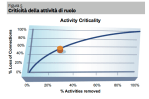
Networks placed where there are concentrations of demand on only a few nodes suggest the presence of critical units that are potentially at risk of becoming bottlenecks in the organisation. We can measure and carry out benchmarks of these bottlenecks by making an estimate of criticalities (figure 5):

Schermata-2012-07-02-a-21

We can notice how 27% of activities correspond to 50% of connections. Although we would not expect all activities to be equally in demand, this diagram provides us with a scale of the organisation’s robustness. For example, if we found a business in which the main activities (10%) represented 50% of the connections, we would have to deduce that the organisation in question was much more vulnerable (from the point of view of achieving inferior performance) than the company that we examined in our case study.

Value Sources and Value Sinks

When we look at a map of an organisation from the point of view of supply and demand of value, it is possible to understand how various roles and the activities they perform relate to each other by identifying the roles from which there is higher demand for help and those which supply more help. If a correct mapping is carried out, it is also possible to identify the balance of the company by identifying the Value Sources (those in demand) and the Value Sinks (those who demand).

Figure 6 shows a map highlighting the connections between nodes of the same network in relation to supply and demand. In this case the colours identify the Value Sources or the Value Sinks. The size of the nodes depends on the number of connections and the thickness of the linking lines identifies the strength of dependence. Value Sinks are roles that tend to demand more than they supply, whilst the opposite can be said of Value Sources.

What should we try to deduce from this analysis? On a first, more superficial, level, we can note that Value Sinks are negative because they drain energy and demand more than they supply, so they require constant work. On a second level, we can understand how even Value Sources, if too strong, can be negative. This is because the widened size of one of the nodes shows a lack of capability to respond effectively and efficiently to the organisation network. And perhaps a lack of capability could be due to a lack of desire to draw knowledge from other sources.

In this case study, showing the analysis results to individuals in charge of the organisation caused a considerable amount of discussion, also due to the fact that an ONA had been conducted for the first time. We highlighted for the executive committee the example of the change management unit as a Value Sink, which appeared as a node able to absorb large resources compared to the amount it supplies. The CIO informed us that the unit had been broken up just a few days before, suggesting that the analysis conducted was valid.

Schermata-2012-07-02-a-21

New visions and future implications

We have already underlined our belief that ONA can be a useful method able to provide a detailed business process analysis without wasting excessive resources, especially compared to BPM and Value Network Analysis.

The analysis of Value Sources and Value Sinks allowed us to immediately identify the areas requiring a more detailed analysis or a greater amount of attention than others. When we identify some business units as Value Sources or Value Sinks, we can ask ourselves why our business has assumed this organisational dimension. For example, we can review the competency level of the individual units that have been identified as Value Sources or Value Sinks.

Figure 7 suggests some possible improvement interventions for the Value Sink/Value Sources issue. A low competency Value Sink can be explained in light of a new position, of a new hire or in any case of any skill-set being formed and that is still gaining the correct competencies to interact with the other roles. The action to take could therefore be to support the role (in terms of time and competencies) in an attempt to make it become more efficient. If the Value Sink is instead highly competent, it is possible that it is not so visible – or accessible – within the organisation and a possible solution could be to promote its role or review the network configuration. In other cases, such as the Change Management Business Unit of our case study, we could consider breaking up and reassigning that role to other roles.

As regards Value Sources with low competency, their roles should be trained and helped to access different roles, so that they can improve their own competency and grow. If the Value Sources are already competent it is therefore possible that their existing resources are insufficient and the demand cannot be efficiently met.

The ONA results can also be usefully used to focus on the processes and activities carried out by Value Networks. A specific focus on the interaction with a good number of Value Sources and Sinks is likely to provide the best return when applied to these complementary analytical techniques.

Schermata-2012-07-02-a-21

Conclusions

We have presented Organisational Network Analysis as a technique to review the approach to Business Process Mapping and more focused on the personal and organizational dimension.

We have called these new business models Value Shop and Value Networks, which are much more dependent on the optimisation of the processes within them, on the general improvement of competencies and on the certainty that information and knowledge are truly shared within the whole organisation. In cases like these, simply mapping the work processes prevents us from grasping the real essence and concrete configuration of the business.

We have distinguished ONA from SNA suggesting that, by maintaining the focus on the role, rather than on the personal level, organisations were freer to operate without running into legal constraints caused by the management of employees’ privacy. The case study was used to show how a simple application – on a limited sample – of ONA is able to provide useful information for interpreting the organisational context and the functioning of processes at multiple levels of association. Through a simple analysis of Value Sinks and Value Sources, businesses can easily identify internal problems and take quick action in ord
er to curb them. Alternatively, it provides a valid starting point that can be crossed with other analyses already experimented with, such as Value Network Analysis and Business Process Mapping.

Originally posted on Social Business Manifesto – An Harvard Business Review Italia publication. Written by Laurence Lock Lee and Rosario Sica – http://socialbusinessmanifesto.com/